Webinar: Bridging IT–OT Gaps: OT-Led Data Transformation in Action

The Hidden Costs of Poor Change Management in Industrial Operations

The Overlooked Risk That Can Sink Your Digital Transformation

Industrial leaders in oil & gas, energy, mining, and pulp & paper understand the stakes when it comes to digital transformation. Yet, 70% of digital transformation initiatives fail—and poor change management is often the culprit.

When organizations focus purely on technology implementation and ignore the people factor, the hidden costs start piling up:

  • Operational inefficiencies caused by poor adoption of new systems.
  • Increased downtime from employees struggling to adjust to new processes.
  • Low workforce morale and high turnover due to unclear communication and lack of leadership support.
  • Rework and compliance failures from resistance and misalignment across teams.


The cost of neglecting change management is not just financial—it’s cultural, strategic, and operational. Without the right change management approach, even the best technology investments fail to deliver long-term impact.

The Real Price of Poor Change Management

1. Unplanned Downtime and Productivity Losses

When employees aren’t properly equipped to embrace new technology or processes, downtime skyrockets.

Case in Point: An oil refinery invested millions in a new asset management system but failed to engage frontline operators in the transition. The result? Operators defaulted to old workflows, leading to costly manual workarounds and extended outages.

Insight: Change adoption is not automatic—it must be actively managed through structured communication, training, and reinforcement.

2. Lost Talent and Employee Resistance

Industrial organizations face a knowledge drain when employees resist change—or worse, leave altogether.

Case in Point: A mining company introduced a new data analytics platform but failed to communicate its benefits clearly to operators. Employees saw it as a threat to their job security rather than a tool to improve their workflows. Key personnel left, taking critical knowledge with them, delaying adoption and forcing the company to hire and retrain new staff at a high cost.

Insight: Change without buy-in breeds resistance. Employees must understand why a change is happening and how it benefits them directly.

3. Regulatory Compliance Risks

In highly regulated industries like oil & gas and energy, compliance failures can lead to fines, legal issues, and reputational damage.

Case in Point: A power generation company introduced a new environmental compliance reporting system but failed to properly train plant managers. The result? Inaccurate data entries and missed regulatory deadlines, triggering audits and penalties.

Insight: Compliance requires consistent training, clear communication, and leadership alignment. A well-structured change management approach ensures regulatory standards are met without disruption.

4. Rework and Project “Do-Overs”

Poorly managed change often leads to failed implementations—forcing companies to redo projects at significant cost.

Case in Point: A pipeline operator invested in a centralized control system but underestimated the cultural shift required. Operators at remote sites resisted the change, continuing with legacy processes. The result? The project had to be restarted, doubling costs and delaying efficiency gains by two years.

Insight: Rework is expensive. Investing in proactive change management prevents wasted time and resources.

How to Avoid These Pitfalls: A Change Management Framework That Works

1. Align Leadership from Day One

Digital transformation isn’t just an IT initiative—it’s a business-wide shift. Leaders must champion the change, not just approve the budget.

Actionable Step: Clearly define leadership roles in the transformation process. Provide executives and middle managers with the tools to communicate the vision effectively.

2. Engage Employees Early and Often

Employees who feel heard and involved are more likely to embrace change.

Actionable Step: Conduct stakeholder impact assessments. Identify key influencers within your workforce and turn them into change champions.

3. Provide the Right Training—at the Right Time

One-size-fits-all training doesn’t work. Employees need ongoing, role-specific training to feel confident using new systems.

Actionable Step: Move beyond traditional training sessions. Implement on-demand microlearning, real-world case studies, and peer mentoring programs.

4. Measure and Sustain Change Over Time

Change doesn’t end at Go-Live. Continuous monitoring and adaptation are required to ensure long-term adoption.

Actionable Step: Set clear success metrics for adoption, proficiency, and impact. Conduct post-implementation reviews and gather feedback regularly.

Advance Your Understanding of Change Management in Industrial Digital Transformation

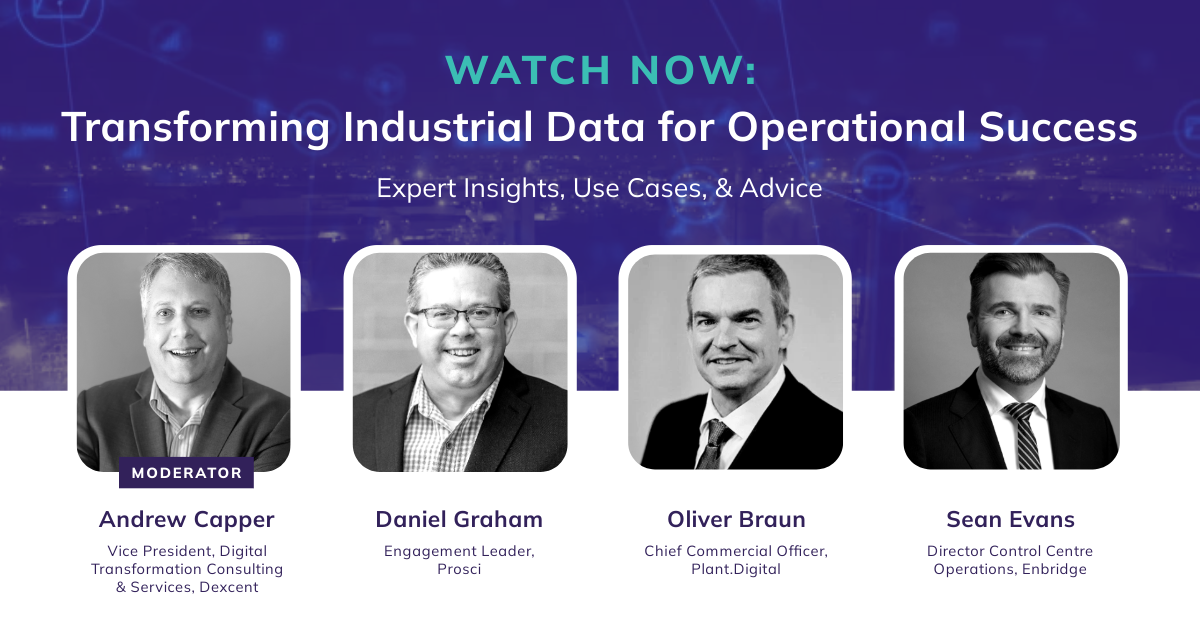
Ensuring your industrial digital transformation initiatives succeed requires effectively managing the people side of change. Learn how to overcome challenges like resistance, misalignment, and fatigue to drive adoption and achieve lasting impact. Access our expert panel session, “Transforming Industrial Data for Operational Success,” for practical strategies to navigate key barriers, ensure adoption at all levels, and build a long-term change management framework that delivers sustainment. Hear directly from industrial leaders and practitioners who share real-world case studies.

Click the graphic below to learn more and access the session.
Final Thought: Change Management Is a Strategic Imperative

Industrial digital transformation isn’t just about technology—it’s about people. Without a structured change management approach, even the most advanced tools will fall short of their potential.

The good news? You don’t have to navigate this alone.

Don’t let change failure become a costly reality—learn how to lead transformation with confidence.


Andrew Capper

Vice President of Industrial Digital Transformation

Read Bio

Andrew Capper is Vice President of Industrial Digital Transformation at Dexcent, helping industrial organizations improve data-driven decision-making by optimizing the data journey, reuniting siloed information, and delivering a trustworthy version of the truth.

With more than 25 years of experience, he is known as a results-driven leader who delivers on commitments and tackles complex information management challenges with a practical, human-centric approach. His work spans digital transformation strategy and roadmaps, governance, digital maturity assessments, and performance measurement through clear KPIs and metrics. Andrew is a NAIT graduate with training in Instrumentation Engineering Technology and Security Systems, and he brings a strong focus on safer, more effective operations from data producers through to data consumers

Nader Asgharinia

MP, P.Eng.

Vice President of Enterprise SCADA & Advanced Applications.

Read Bio

Nader Asgharinia, PMP, P.Eng., is Vice President of Enterprise SCADA & Advanced Applications at Dexcent, leading the delivery of complex, mission-critical solutions with a clear focus on client experience and operational excellence. With more than 30 years in business execution and over 25 years managing multi-million-dollar programs for mission-critical and SCADA systems, he brings a pragmatic, delivery-at-scale approach to every engagement. Nader is recognized for building high-performing teams, driving disciplined portfolio execution, and delivering measurable business outcomes, including significant growth in program portfolios and team capacity over time. He holds a B.Sc.(Hons.) in Electrical and Electronics Engineering from the University of Newcastle-Upon-Type in the UK, a B.Sc. in Computer Science from the University of Calgary, completed Georgetown University’s Director’s Program, is a Professional Engineer in Alberta, and a Project Management Professional.

Gerrit Nel

CISSP, CISM – Vice President of OT Infrastructure and Cyber Security Services

Read Bio

Tobias (Gerrit) Nel, CISSP, CISM, is Vice President of OT Infrastructure and Cyber Security Services at Dexcent, leading the development and delivery of practical services and solutions that integrate, complement, or replace OT infrastructure and protect OT assets from cyber threats. He is known for building resilient security frameworks, governance processes, and integrated solutions that reduce risk and support compliance across diverse industries. Gerrit has over 40 years of relevant IT/OT experience and has built and delivered highly skilled and high-performance delivery teams. His strengths include Cyber Security roadmaps, security architecture, incident response, and alignment to standards such as IEC 62443, NIST, and NERC CIP. Furthermore, he has deep foundational technical experience in Networking and OT infrastructure systems architectures that he leverages in building and leading successful delivery teams. Gerrit holds a B.Sc. in Computer Science from the University of Johannesburg and brings deep cross-sector experience supporting clients in oil and gas, mining, chemical, healthcare, financial, and government environments.

Jaydeep Deshpande

P.Eng. – President

Read Bio

Jaydeep Deshpande, P.Eng., is a seasoned and decisive executive with over 25 years of experience driving operational excellence, profitability, and market growth in national and multinational organizations. As President, he is recognized for his strategic leadership, disciplined execution, and ability to lead organizations through change. Jaydeep is passionate about developing people, building strong leadership teams, and fostering a positive, performance-driven culture. His expertise spans strategic planning, business diversification, financial management, and organizational transformation, with a consistent focus on delivering growth-oriented, profitable results. He holds a Bachelor of Chemical Engineering from the University of Alberta, is a Prosci Certified Change Practitioner and Project Management Professional (PMP), and has completed the CMA Accelerated Accounting Program, bringing deep financial and strategic insight to executive decision-making.

Karim Amarshi

Chairman of the Board

Read Bio

Karim Amarshi is Chair of Dexcent’s Board of Directors, providing governance leadership and strategic oversight to support the company’s long-term strategy and executive team. With nearly 40 years as an entrepreneur and owner-operator, he is recognized for building high-performance organizations and forging strategic alliances across Information Technology, government, health care, education, and energy. He is the former co-owner and Chief Executive Officer of one of Canada’s leading enterprise Information Technology solution providers, where he led the organization through three successful mergers and helped scale long-term client and vendor partnerships. Karim remains active across a diverse business portfolio, serving as a founding principal, officer, and advisor to organizations spanning Information Technology, hospitality, manufacturing, retail, and real estate in Canada and internationally.

Yasmin Jivraj

FCIPS, I.S.P. | Board Member

Read Bio

Yasmin Jivraj, FCIPS, I.S.P., is a Board Member at Dexcent, providing executive guidance and strategic oversight to support corporate management and long-term business direction. Over a 35-year career, she has held senior leadership roles across private, public, and non-profit organizations, with a track record of building operating foundations and driving profitable growth. Following a 15-year tenure as a co-owner and President of one of Canada’s leading strategic Information Technology solution providers, she expanded her governance leadership through active board service in post-secondary education and community-focused organizations. She is recognized for decisive, purpose-led leadership, clear communication, and deep expertise in technology, business models, and methodologies that help enterprise organizations advance digital transformation.

Nadir Jivraj

CEO, Board Member

Read Bio

As Chief Executive Officer, Nadir is accountable for providing overall leadership and Dexcent’s Industrial operational performance. Nadir has been involved as an executive sponsor with Oil & Gas and Mining companies for over 35 years, and through the years has developed a strong working relationship with the Executive leadership team of many Fortune 500 companies.

Nadir is known for recognizing value and superior investment opportunities in the technology services sector. His pursuit of highly prospective technology companies around the world has resulted in numerous company start-ups. Prior to starting Dexcent, Nadir had led companies through highly profitable business transactions, including the merger of Atlas Systems Group with CompCanada (later renamed Acrodex) in 2000 and later as Chairman of the Board of Axcend Pvt – an engineering solutions provider – based in Bangalore, India from 2004 – 2014. Acrodex and Axcend were sold in 2015