Why OT Modernization Projects Fail Before They Start
When organizations begin planning an OT modernization project, they usually focus on the execution: timelines, technology choices, vendor selection, commissioning schedules, and cutover planning. But in reality, most modernization projects fail long before any of those steps occur.
They fail at the starting line.
The true cause of failure is rarely the technology or even the implementation. Most failures trace back to something more fundamental: the system was never ready for modernization in the first place. The architecture underneath it was inconsistent, undocumented, drifted, or incapable of supporting the performance, security, and scalability that the modern solution required.
This article explores the real reasons modernization efforts struggle and what organizations must address before they commit time, resources, and capital to any upgrade.
Modernization Assumes Readiness. Most OT Environments Are Not Ready.
Modernization often begins with a business driver: new production demands, aging hardware, performance constraints, Cyber Security requirements, analytics initiatives, or regulatory expectations. Leaders identify the technology they want to introduce and build a project plan around it.
But almost every modern OT technology relies on architectural strength that many legacy environments simply do not have. When modernization is applied on top of that weak foundation, the project exposes inconsistencies and hidden issues that were not visible before the work began.
What looked like a small or straightforward upgrade suddenly becomes a chain reaction of unexpected complexity.
Modernization fails not because the vision is wrong, but because the environment is not prepared to support the vision.

The “Assumption Trap” That Derails OT Projects
Most modernization projects begin with assumptions that seem reasonable on the surface:
- “Our network is stable, so it should support this.”
- “We have diagrams from the last upgrade.”
- “Nothing has changed significantly since the last project.”
- “The vendor built it, so it must follow their standards.”
- “This should be an easy integration.”
But these assumptions overlook how OT systems actually evolve.
They change incrementally, often without documentation. Vendors make adjustments. Operational workarounds become permanent. Small drift creates misalignment. And over time, the actual system diverges quietly from what people believe it to be.
Modernization exposes this gap because new technology is far less forgiving of architectural weakness than the legacy systems it replaces.
Assumptions are the hidden risks that sabotage even the best modernization plans.
Where Modernization Projects Most Commonly Break Down
Although the symptoms differ from site to site, the root causes follow predictable patterns.
1. Incomplete or outdated visibility of the current state
If teams cannot see the real environment, they design against a fictional one.
2. Architectural drift that undermines performance
Small inconsistencies add up, creating bottlenecks and unpredictable behaviour.
3. Weak non-functional requirements
When performance, scalability, maintainability, and throughput are not defined early, the system may function but not perform.
4. Misaligned design assumptions
Even strong designs fail when they do not reflect field realities.
5. Hidden dependencies that appear during commissioning
New systems trigger communication paths, data flows, or load conditions that old infrastructure cannot support.
6. Insufficient high availability to enable safe change
Upgrades require windows and failover options that the legacy system cannot provide.
These gaps turn what should be a progression into a disruption.

Why IT Modernization Frameworks Cannot Simply Be Mapped to OT
Many organizations assume that principles used in IT modernization can be applied directly to OT environments. This is a costly assumption.
In OT:
- Downtime is far more expensive.
- Commissioning windows are limited.
- Systems cannot simply be rebooted.
- Legacy assets remain critical to operations.
- Vendor-specific dependencies complicate integration.
- Network paths cannot always be adjusted on demand.
Modernization requires more than project management.
It requires architectural alignment.
Modernization Depends on the Quality of the Foundation Beneath It
Every modernization effort touches architecture in some way. Even small upgrades introduce changes that require:
- Predictable traffic flow
- Clear segmentation
- Accurate documentation
- Confirmed bandwidth and throughput
- Clear dependencies
- Stable routing paths
- Reliable naming conventions
- Up-to-date switches, firewalls, and servers
If the foundation is inconsistent or unclear, modernization amplifies those weaknesses.
A strong architecture does not guarantee modernization success.
But a weak architecture guarantees modernization failure.
The Hidden Costs of Starting Too Soon
Organizations often underestimate the cost of pressing ahead before the environment is ready. Common side effects include:
- Increased engineering time discovering the real system
- Unplanned redesign efforts partway through the project
- Rework during commissioning
- Poor system performance after go-live
- Inability to scale with future requirements
- Delayed Cyber Security improvements
- Loss of stakeholder confidence in modernization initiatives
These issues are expensive, but more importantly, they are avoidable.
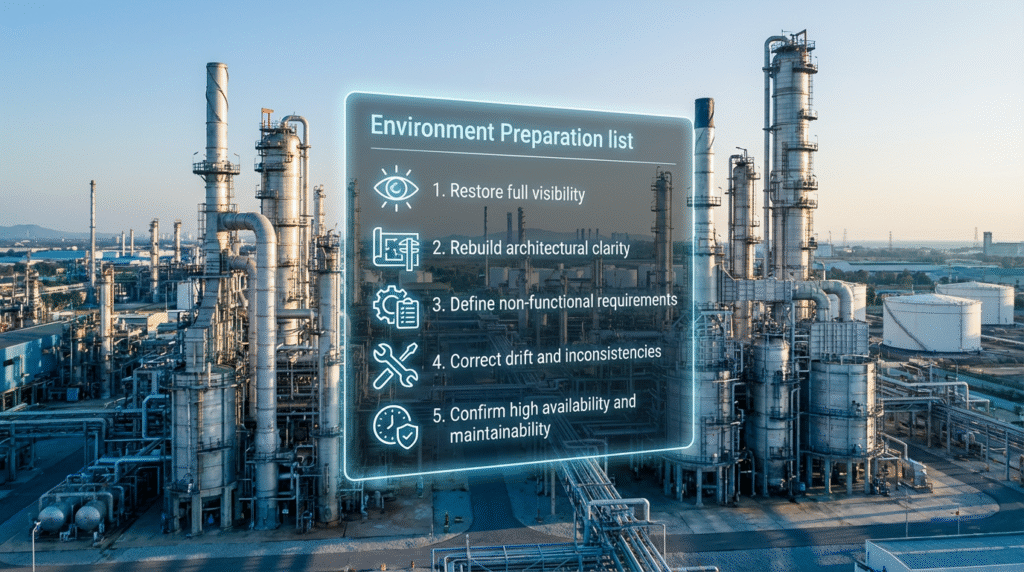
How Organizations Can Prepare the Environment Before Modernization
Successful modernization begins with a deliberate, structured set of actions:
1. Restore full visibility
Confirm the real system, not the assumed one.
2. Rebuild architectural clarity
Align communication paths, naming standards, redundancy, and segmentation.
3. Define non-functional requirements
Understand what the system must support, not just what it must do.
4. Correct drift and inconsistencies
Eliminate the weak points that will otherwise reappear during commissioning.
5. Confirm high availability and maintainability
Ensure the environment can be updated and supported safely.
With these elements in place, modernization moves from risky to predictable.
The Path Forward
Dexcent helps organizations validate readiness, rebuild clarity, and design architectures capable of supporting modernization without introducing risk. We bridge the gap between what teams want to achieve and what the current system can reliably support.
Modernization should move you forward, not into uncertainty.
Strengthening the foundation is how that happens.
Explore This Topic More Deeply in the Full Guide
If this article highlighted challenges you have seen in past upgrades or upcoming projects, the ebook provides a deeper look at how to strengthen your architecture before modernization begins.
Download the free ebook:
Building the Backbone of Resilience.
If You Need Clarity on Your Own Environment
If you need to confirm whether your environment is ready for modernization, Dexcent can help you assess current conditions and identify the steps that will reduce risk and increase confidence.
Talk to a Dexcent OT architecture specialist.
Together, we can determine the most reliable path forward.